There is something distinctly British about measuring intoxication with numerical precision.
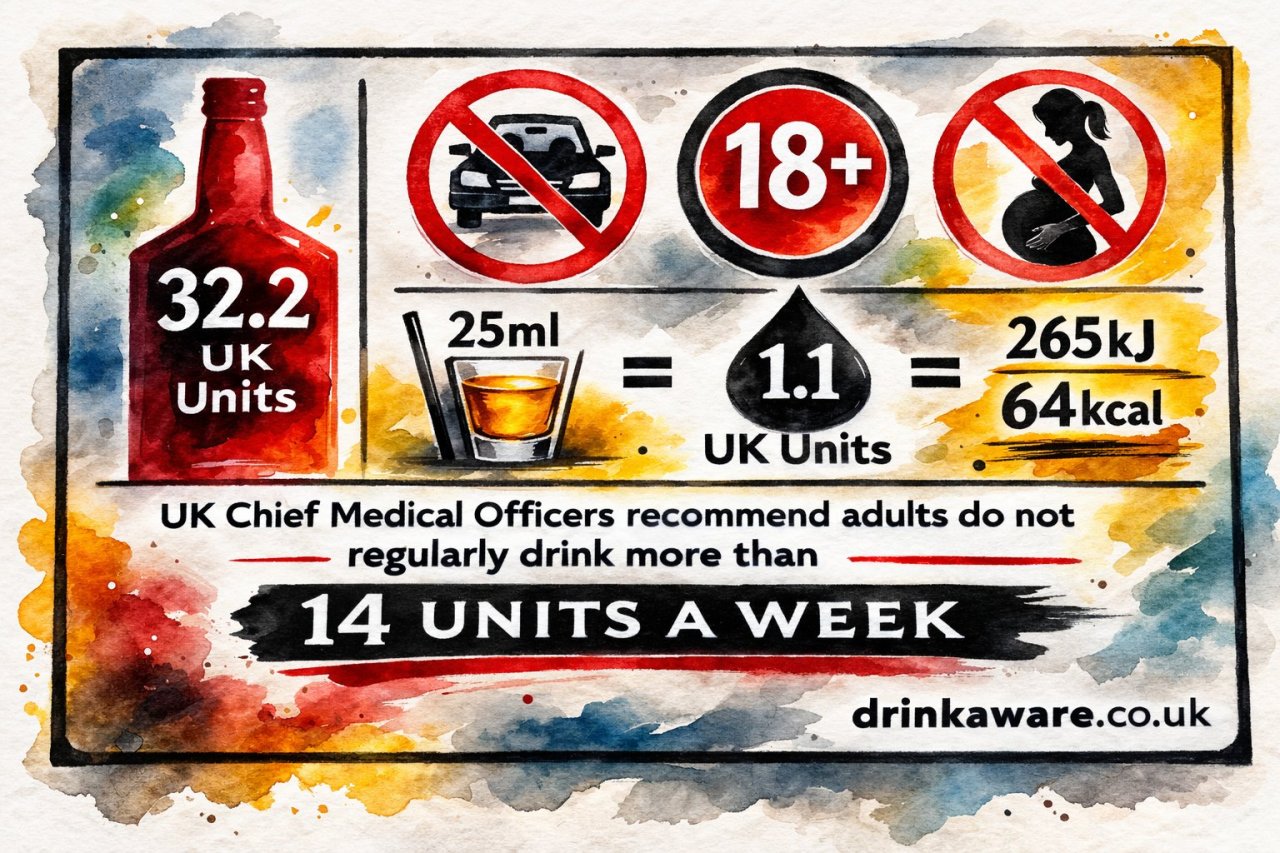
In the United Kingdom, alcohol is quantified in “units.” One unit equals 10 millilitres, or 8 grams, of pure ethanol. That figure is deliberate. It creates a standardized method for estimating alcohol intake regardless of whether it comes from beer, wine, or spirits. A 25 ml shot of 40 percent tequila contains one unit. A 175 ml glass of 12 percent wine contains about 2.1 units. A pint of 5 percent beer contains roughly 2.8 units.
The UK introduced the unit system in 1987 as part of a national public health strategy. Before that, advice around drinking was inconsistent and often vague. Officials wanted a clear, measurable framework that people could understand. Instead of warning the public in abstract terms, the government created a numerical reference point based on pure alcohol content.
This approach reflects a simple biological fact. Alcohol is pharmacology, not just culture. Ethanol is a small molecule that travels rapidly through the body. After consumption, it is absorbed mainly in the small intestine and enters the bloodstream. From there it circulates to all organs, including the brain, where it alters neurotransmitters and affects coordination, judgment, and perception.
The organ that determines the pace of this process is the liver. A healthy adult liver metabolizes on average about 7 to 10 grams of pure alcohol per hour. That is approximately one UK unit per hour. This rate is limited by enzyme activity, primarily alcohol dehydrogenase, which converts ethanol into acetaldehyde, a toxic intermediate compound. Acetaldehyde is then converted into acetate and eventually broken down into carbon dioxide and water.
This metabolic speed is relatively constant. Drinking coffee does not accelerate it. Exercise does not meaningfully increase it. Time remains the only reliable mechanism for reducing blood alcohol concentration. If a person consumes alcohol faster than the liver can process it, alcohol accumulates in the bloodstream and impairment increases.
The UK unit system aligns closely with this biological constraint. If one unit contains about 8 grams of ethanol and the liver clears roughly that amount per hour, the arithmetic becomes intuitive. Three units require approximately three hours for the body to metabolize. Individual differences exist, including body mass, sex, genetics, and food intake, but the framework provides a practical estimate grounded in physiology.
Current UK low risk drinking guidelines, updated in 2016 by the Chief Medical Officers, recommend that both men and women consume no more than 14 units per week. These units should ideally be spread over several days, with alcohol free days included. Fourteen units correspond to roughly six pints of average strength beer or six medium glasses of wine.
Across Europe, other countries use similar concepts, though the exact definitions vary. The European Union does not impose binding alcohol limits. Health policy remains primarily national. However, many countries define a “standard drink” to guide consumption.
In Germany, federal health authorities suggest that men limit themselves to around 24 grams of pure alcohol per day and women to around 12 grams, with alcohol free days recommended. In France, public health guidance advises no more than two standard drinks per day, not every day, and no more than ten per week. In Italy, earlier recommendations allowed up to two to three alcohol units per day for men, though public messaging has shifted toward more cautious consumption.
Most European standard drinks contain between 8 and 14 grams of pure alcohol. The UK unit, at 8 grams, sits at the lower end of that range, making it one of the more conservative definitions.
Historically, alcohol regulation in the UK began as a response to social disorder rather than liver science. The Licensing Act of 1872 criminalized public drunkenness. During the First World War, pub opening hours were restricted to maintain productivity in factories and munitions plants. The temperance movement framed alcohol as a moral issue. Only in the late twentieth century did governments begin to translate drinking behavior into epidemiological data and biochemical limits.
As medical research advanced, risk became quantifiable. Studies demonstrated that long term alcohol related harm correlates with cumulative exposure. Liver disease, certain cancers, and cardiovascular risks increase as total consumption rises. The liver’s hourly metabolic capacity explains short term intoxication, while long term harm reflects repeated stress on metabolic pathways and tissue.
The UK unit system represents an attempt to convert enzymatic chemistry into everyday language. It bridges pub culture and biochemistry. It acknowledges that while alcohol plays a role in social rituals and celebration, the human body operates according to fixed metabolic rules.
Serving sizes and units are therefore less about moral judgment and more about biological realism. The liver functions at a steady pace. It does not accelerate in response to enthusiasm. Public health guidance attempts to align drinking habits with that quiet internal arithmetic.
Behind every glass stands a small, tireless organ performing steady chemical conversions. The numbers on a label are not arbitrary. They are a reflection of the limits of human metabolism, expressed in millilitres and grams rather than in hangovers and hospital admissions.